In an emergency Police 117 | Ambulance 144
Violence and seniors – “Invisible violence!”
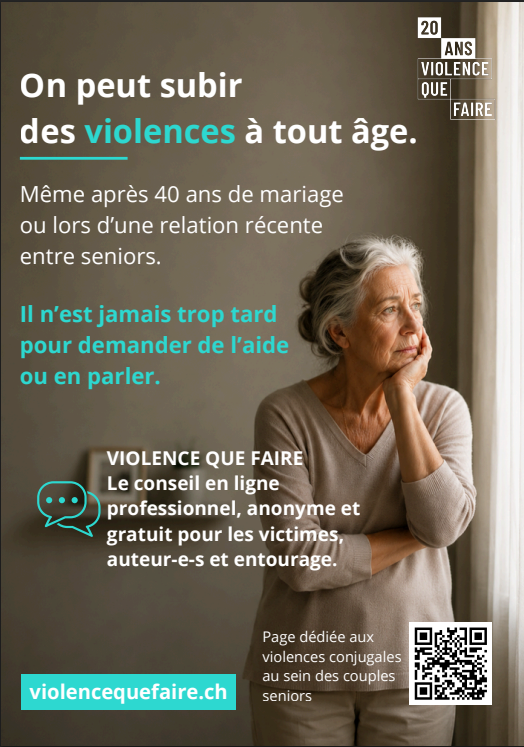
Senior couples can also be affected by intimate partner violence, whether psychological, physical, sexual or economic. Yet people aged 65 and over still rarely seek support. This violence remains largely unrecognised and invisible, particularly due to social isolation and support services that are not always adapted to the realities and needs of seniors.
Over the past decade, 20% of femicide victims in Switzerland were of retirement age, making seniors the age group most affected. In two-thirds of cases, the perpetrator was someone close to the victim, such as a partner or former partner.
It is not always easy to know where to turn for help. Some seniors have limited knowledge of the support services available or face difficulties accessing them, particularly due to reduced mobility or independence. A lack of prevention campaigns and limited access to information, especially online, can further reinforce these barriers.
Seniors with a migration background may also face language barriers, administrative complexity, economic inequalities or social isolation. In addition, some services and support structures are not sufficiently accessible to seniors. Emergency accommodation may require residents to be independent in their daily lives, while consultations often take place in person, which can be a barrier for people with limited mobility or independence.
A study by the national competence centre Vieillesse sans Violence (“Ageing without Violence”) highlights the importance of gaining a better understanding of these barriers and of the resources specifically available to seniors. This can help people experiencing violence find a way out and enable professionals, family members and others close to them to better identify these situations.
If certain behaviours by your partner make you feel uncomfortable or afraid, isolate you, or make you feel that you are no longer free to make your own decisions, it is entirely valid to question what is happening and to talk about it. You can also seek help if you are concerned about your own behaviour or that of someone close to you.
You may feel that the word “violence” is too strong to describe what you are experiencing, especially if there is no physical violence. However, humiliation, insults, threats, controlling your money, isolation, forced sexual relations or controlling where you go can also be forms of violence.
Social and cultural perceptions have often focused mainly on physical domestic violence. As a result, other forms of violence that a person may experience or use against someone else can be overlooked.
Some generational and social norms can also contribute to making different forms of violence seem normal or acceptable.
Some people grew up with the idea that marriage should last a lifetime, that relationship problems should stay within the family, or that they should not “speak badly” about their partner. These beliefs can make it more difficult to recognise violence and talk about it.
Generational and cultural factors can also influence how we define sexual violence and can even make it more difficult to recognise.
Many people also grew up with the idea that marriage is a lifelong commitment and that the family should be kept together at all costs.
This can lead people to believe that problems should be dealt with within the family, that marriage is “for better or for worse”, or that the husband is the head of the family. They may also worry about “what people will say” or believe that they should not speak badly of someone who has died. Talking about violence within a relationship can therefore create a conflict of loyalty towards the person using violence or towards the family.
Many people grew up with the idea that being married or simply being in a relationship means consenting and committing to sexual relations. The idea of “marital duty” is widespread and can contribute to normalising or minimising rape.
Being married or in a relationship never means automatically consenting to sexual relations. Consent is always necessary, regardless of age or how long the relationship has lasted.
These factors can make violence less visible and make it seem normal. They can also lead the person experiencing violence to feel guilty and become even more isolated.
It can be even more difficult to recognise violence and trust your own feelings when the people around you support these beliefs and norms. Fear of not being understood can also discourage someone from talking about their situation or questioning what they are experiencing.
When a person gradually loses social connections and independence, the idea of asking for help or leaving home can seem overwhelming. As people get older, their social network may become smaller due to retirement, the death of loved ones, mobility problems or loss of independence. This isolation can make it more difficult to seek help.
Social connections are essential for protection against coercive control. A person using coercive control may deliberately target these relationships in order to further isolate the victim and strengthen their control over them. Social isolation is therefore an important risk and vulnerability factor.
When violence has continued for a long time, sometimes even for several decades, talking about it can be very difficult. Many people describe feeling ashamed or guilty about breaking the silence surrounding what they are experiencing.
In small communities, for example, where it can be more difficult to remain anonymous, some victims may be afraid of what other people will think or that their situation will become known to people around them or to their family.
When people around them experience similar situations and minimise violence, this can sometimes reinforce feelings of guilt or the feeling of having “failed” in their marriage or of not being a “good partner”. In this context, breaking the silence can be particularly difficult. In relationships involving coercive control, being repeatedly put down or insulted, and living with constant or unpredictable fear, can further reinforce this silence. Over time, the person may begin to doubt their own feelings, feel responsible for the violence, or adapt to it. Some people also feel ashamed within this cycle of violence because they do not understand why they stay with or return to someone who hurts them.
Feeling shame or guilt is common when experiencing violence. However, responsibility for the violence always lies with the person who uses it.
As people get older, they may become more dependent on their partner, particularly financially or for care and everyday activities. This dependence can make it more difficult to ask for help or move away from a violent relationship. Coercive control, which involves making a person dependent for psychological, financial or health-related reasons, can become stronger in later life, when certain vulnerabilities may increase.
Inequalities can be even greater for women. Taking care of the home and children, combined with pay inequalities during their working lives, can significantly reduce their pension in retirement. This financial gap can increase dependency and economic violence.
Asking for help does not necessarily mean having to leave your home immediately or end your relationship. You can talk about your situation and explore the different options at your own pace.
Many people do not feel able to leave a violent relationship because they think it is too late or that it is no longer worth it. After years of adapting to aggressive behaviour, some people may feel anxious about the idea of leaving.
Some people also feel that they do not have the strength to deal with legal or administrative procedures.
Health problems and financial dependence on a partner can increase the partner’s control and reinforce the fear of not being able to leave the relationship.
Some people are afraid of losing control of the situation, having to leave their home, the violence becoming more serious, or having to move into a care home.
Difficulty talking about the situation and finding appropriate support for specific financial, care or psychological needs can be major barriers that discourage people from seeking help.
Family members, friends and other people close to the person can be an important source of support, both in recognising violence within the relationship and in finding appropriate support and solutions.
Some signs may be a cause for concern: isolation, controlling behaviour by a partner (e.g. the person cannot dress the way they want or do what they want), or minimising violence towards a partner (e.g. through humiliating jokes or jokes about hurting or abusing them).
It is often necessary to break the silence surrounding violence. Sometimes, this means having the courage to ask how the relationship is going in general, what happens when there is conflict, or whether the person has ever felt in danger.
A person experiencing violence in their relationship is going through a difficult and painful situation, which may involve fear, shame or loneliness. To open up a conversation, it is important to listen with empathy, without judgement, and to respect the person’s pace. Putting pressure on the victim or making them feel guilty should be avoided, as this may isolate them even further.
It is important to condemn the violence while maintaining a connection with the person. Listening and offering support without imposing conditions (e.g. “You have to leave your partner”) can be a valuable way of supporting them at their own pace and providing a safe space.
Being a witness to violence can play a key but also challenging role. It can sometimes be difficult to deal with. It is therefore important not to carry this responsibility alone and to have someone you can talk to confidentially.